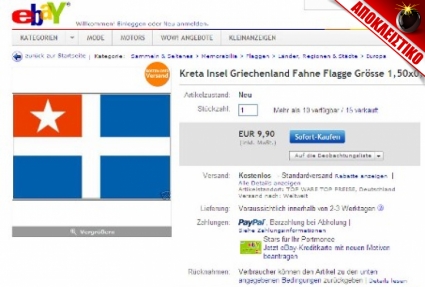
Is the island of Crete an independent state? Of course, it is not! However an ‘agent provocatuer’ based in Sinzheim-Winden in South Germany, sells ‘Cretan’ flags on e-bay. Sold at the pot price of EUR 9,90 the sneaky entrepreneur has already sold 15 pieces of the flags of a non-existing state.
What purposes this provocation servers I can’t tell you but there seem to be quite a background on the idea of promoting an Independent Cretan State in Germany. According to portal newsbomb the Greek Foreign Ministry has been informed about this “vile provocation” and is expected to submit a complain to the German government and the server e-bay.

The entrepreneur describes the flag as ‘historical flag of Crete until 1912″ but Greeks are very touchy on the issue as in the recent past there have been other provocative actions claiming that certain circles on Crete had been favoring an independent state.
The historical flag of the Cretan state (1898-1913) is depicted by the blue squares and the white cross of the Greek flag and a red square with a star symbolizing the Ottoman (modern Turkey) suzerainty (see more details here )
E-bay Flag Link

Indepentant Crete: real movement, provocation or just a conspirancy theory?
I found a very interesting article on internet about this allegedly “Independent Crete” movement. The article “Independent Crete -Cretan State – Cretan Flag: Time-bomb, Provocation or Bubble?”is in Greek and thus very long to translate it in whole length.

The Cretan State
The whole thing starts from the date of 1912-13 during which signed the Treaty of London. From 1898 (formally in 1896 under the Treaty of Berlin), Crete was an autonomous part of the Ottoman Empire (with simultaneous control of the Great Powers).It was called “Cretan State” and its capital was Chania. It had its own flag, parliament, Gendarme (under foreign management), constitution, anthem, currency, medals, etc., which were basically variations of those in the Greek state.
Essentially, the ‘governance’ of the Cretan State, carried out by a joint board made up from individual boards of Crete and the Great Powers. The Board, however, the Great Powers had essentially the leadership as it had the right at any time, suspend the operation of the Board of Crete and to seek reinstatement, if considered in breach of any limits or arbitrary.
The foreign policy of the island remained captive of the “protectors” of. The Cretan State example had no right of war and relations with other states passed essentially the adoption of the Great Powers. Partly because of high sovereignty of the Sultan on the island were not allowed up Cretan military body (instead created the so-called “militia”, which of course had no military role and power).The flag of the “Cretan State”
The flag of the “Cretan State” based on a variant of the Greek flag in 1822. Three-quarters blue symbolizes the Christian-majority Greek island of Crete. The first quarter (red, which is attributed to the Muslim Turkish minority), which depicted a white star, symbol and indicated the high dominion of the Sultan on the island.It should be stressed here that it has never been an independent state in Crete, but a (semi) autonomous region and fully controlled by the Great Powers.
Therefore, the flag does not symbolize the independent Crete but his allegiance to the Ottoman leaders, as the island was still a territorial division of the Ottoman Empire. Moreover, this flag has never been racing banner or revolutionary symbol introduced by the Cretans, but it was an invention of the Great Powers and the Sultan (the star came at his request).
The flag of the Cretan State, therefore, beyond which the historical importance and presence in modern history, it is a symbol which should create ‘chills’ emotions and feelings of “pride” .The first movement
A “Independent Crete” does not seem to target just one country, or at least, separatist movements are not motivated only by a but more (mainly, Turkey, Israel, Germany, England, USA).
In early 1990 the authorities of Crete began to focus their research around greeting some anonymous letters sent to local newspapers New Year’s Eve and Easter. These letters were cartoons that had Greece as a monster, extending his hand and strangle the island. The crucial question that was asked to answer all those who were inciting action.
In the years that followed, the authorities noticed an attempt to fall tones. The secret investigations have brought abroad had led at one point required the promoters to … suspend the plan. Temporarily, as demonstrated …
In the last two years there has been a campaign to spread the Cretan State idea and the results are extremely worrying for the authorities. More and more flags “decorate’ ‘homes, while dozens more cars (and even prominent Cretans) have placed the symbol of the Cretan State on the plates. Also there are hundreds of SMS and MMS arriving on the mobile phones. The phenomenon is more pronounced in Heraklion, where authorities have documented hundreds of cases of people (both in the city and in villages) that have made their central slogan of the “Cretan State” and the vision of “autonomous Crete”.
The security authorities have reliable information that this mobility … driven primarily by business groups operating abroad, spearheaded by Germany. Many Cretans receive e-mail with similar content that urges them to unite for the grand vision of the independence of Crete. Press reports indicate that all activity is stimulated and financed by an organization based in Germany. They even come in and lead. This was a man of Cretan origin with a strong position and role abroad, but as the name is not known on the island. Moreover, several investigations have resulted in some people who serve Turkish interests (source: pare-dose.net, posted Jan 17, 2008)
A real movement, a provocation or a conspiracy theory?
In Wikipedia’s History of Crete there is a chapter titled Cretan State and another link here